
welcome
Your pre-meeting resource hub
Everything you need to understand our system, all in one place.
This hub is designed to show you exactly how our client acquisition system works. From the ads that start the journey to the nurture sequences that build trust. Explore at your own pace, try out the tools, and see for yourself how each piece fits together.
The Journey at a Glance
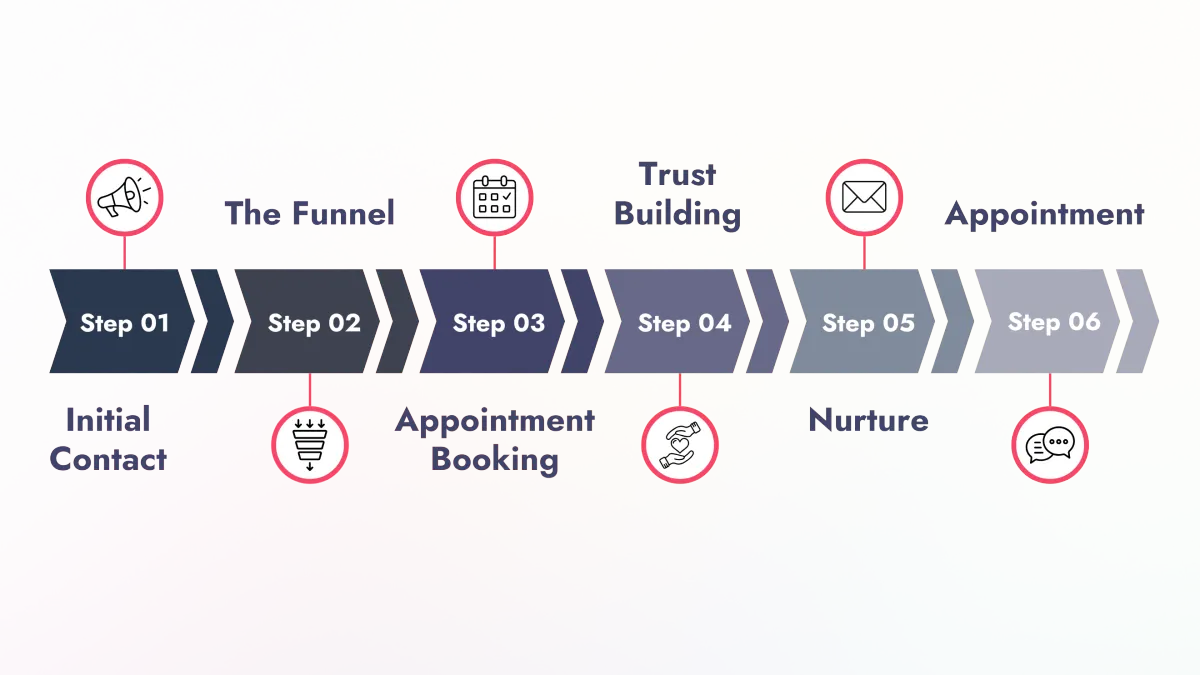
Every business needs a reliable way of turning strangers into clients. Most advisers and service professionals rely heavily on referrals, word of mouth, or bought-in leads. That works some of the time but it isn’t predictable, and it isn’t scalable.
The system we use is designed to remove that uncertainty by creating a clear journey for your prospects.
This isn’t about shortcuts or gimmicks. It’s about putting structure around the way people already make decisions: they notice you, they get curious, they build trust, and then they reach out.
Initial Contact – A light-touch introduction, whether through an ad, email, or outreach. The goal is simply to spark interest, not to push for a sale.
The Funnel – A short, focused set of questions that frames the problem and positions you as the solution. At the end, the prospect is invited to book a time with you.
Resource Hub – A central page that explains your process, showcases expertise, and provides helpful resources. It builds trust by being transparent and giving value upfront.
Nurture & Follow-Up – Automated emails and messages that share insights, case studies, and tools. These keep the conversation alive and demonstrate credibility over time.
The Appointment – By the time someone books, they’ve already seen proof, value, and reassurance. The call isn’t a cold introduction, it’s a continuation of a journey that’s already built trust.
Initial Contact: Ads
Why ads matter
Every client journey starts with awareness. Most professionals rely on referrals or directories, which bring business occasionally but not predictably. Paid ads give you control: they put your message in front of the right audience, at the right time, with consistency.
In this system, ads don’t aim to “sell” immediately. Their job is simple: spark curiosity, start a conversation, and invite people into the next step, the funnel.
How ads fit into the journey
Awareness: Ads introduce who you are and highlight the problem you solve.
Engagement: A clear call to action invites the prospect to answer a few quick questions.
Conversion: Once inside the funnel, they book a consultation.
By the time they reach you, they haven’t just seen an advert, they’ve followed a structured path that builds interest and trust step by step.
Why they work
Targeting: Ads are shown only to carefully defined audiences (by profession, location, demographics, or interests). This means your message reaches people who are most likely to respond.
Clarity: Each ad has a single focus. One message, one call to action. This avoids confusion and improves conversion rates.
Relevance: Messaging speaks directly to the prospect’s situation, framed around challenges they already recognise.
How we create ads
Research: We start with the client’s ideal customer profile — who they are, what they value, and what pain points they have.
Messaging: Copy is written to be clear and approachable, never pushy. It often poses a simple question or highlights a common frustration.
Visuals: Depending on the audience, we use either static images (clean, bold, simple) or video (short, personal, human). Both are designed to catch attention quickly.
Static vs Video
Static Ads:
Work well for direct, snappy messages.
Easy to test different headlines, designs, or offers.
Ideal for remarketing and reinforcing a message.
Video Ads:
Build trust faster by showing personality and authenticity.
Useful for explaining slightly more complex ideas in under a minute.
Excellent at standing out in crowded feeds.
Most campaigns use a mix of both, ensuring coverage across different audience preferences.
Testing and optimisation
Split Testing: We run variations of headlines, images, and calls to action to see what resonates most.
Metrics: Click-through rate, cost per lead, and booking rate are monitored closely.
Iteration: Underperforming ads are paused quickly, and budget is shifted to the best performers.
Creative Refresh: New visuals and copy are introduced regularly to prevent “ad fatigue” where audiences stop noticing the same message.
Key message
All campaigns are actively monitored. This isn’t a “set and forget” process. Performance data is reviewed weekly, adjustments are made, and results are reported back clearly. Over time, this constant refinement lowers costs and increases lead quality.
Funnels and Landing Pages

Why funnels exist
Most websites are built as shop windows; they show information, but they don’t guide people to take a specific action. Funnels are different. They’re designed to move someone forward, step by step, with no distractions.
In this system, the funnel is the bridge between an ad that sparks curiosity and a booked consultation in your diary.
How the funnel works
You’ve probably noticed the short sequence of questions in the gif above. That’s the call booking funnel. The exact one you went through to reach this Resource Hub.
It’s built to do three things:
Engage Quickly – A handful of simple questions get the prospect involved. People are far more likely to stay when they’re clicking, not just reading.
Frame the Problem – The questions aren’t random. They make the prospect think about their current situation and recognise where improvements are needed.
Invite Action – At the end, the next step feels natural: booking a consultation.
Why this approach works
Simplicity – No menus, no distractions. Just one clear journey.
Relevance – The funnel speaks directly to the challenges the prospect faces.
Commitment – By answering a few questions, people make a small investment of time and attention. That makes them more likely to follow through and book.
Creating and testing funnels
Every funnel is tailored to the target audience it serves. Whether that's retirees, parents with growing families or high net worth individuals, the wording, examples, and images are chosen to speak directly to the pain points of the person filling it out.
Design: Clean, mobile-first layouts that work seamlessly on any device.
Copy: Conversational, with a clear tone of voice that reflects professionalism.
Testing: Different versions of questions, headlines, and booking prompts are run to see which deliver the highest booking rate.
The booking step
At the end of the funnel, prospects are offered a choice: book a consultation online or in person. This makes the call-to-action flexible but focused. By this stage, they’ve already acknowledged their pain points, so the booking feels like a logical next step, not a leap.
Key message
The funnel is the turning point in the journey. It transforms curiosity into commitment by guiding people through a short, structured process.
The funnel you saw earlier is more than a demo, it’s the real system at work, and the same structure is rolled out for every client we serve.
Scorecards and Calculators
Why they exist
Sometimes the quickest way to earn trust is to stop talking at people and let them see for themselves. Scorecards and calculators are designed to do exactly that. They give prospects personalised insight into their own situation.
Instead of a sales pitch, you’re giving them something they can interact with, learn from, and use to make better decisions.
How they fit into the journey
At the Top (Ads): Curiosity-driven scorecards like “How strong is your client pipeline?” work perfectly as lead magnets. They give someone a reason to click and engage straight away.
In the Resource Hub: Tools like an ROI calculator demonstrate the value of the system in hard numbers. For example, showing how just one extra client per month more than pays for the system.
In Nurture Campaigns: Just because someone books a call, it doesn't mean they'll show up. Sending a scorecard or calculator by email keeps the relationship alive and gives them another reason to engage with you.
At each stage, the principle is the same: deliver value first, ask for commitment second.
Why they work
Personal: The output is about their business, not generic advice.
Engaging: Answering questions feels easier than reading another sales email.
Action-Oriented: Results pages naturally lead into the next step, whether that’s booking a consultation or exploring further resources.
Example tools
Retirement Readiness Scorecard
Financial Health Check Calculator
Wealth Growth Potential Calculator
Cost of Delay Calculator
Retirement Lifestyle Calculator
Protection Gap Scorecard
Key message
Scorecards and calculators are not add-ons. They’re woven into the journey. They attract attention at the start, demonstrate value in the middle, and keep interest alive over time.
By giving prospects meaningful insights about their own situation, you move from being just another company vying for attention, to being a trusted advisor.
Automated Nurture Sequences

Why they exist
Not every prospect is ready to book a call immediately. Some need more time, more information, or simply a few reminders before they take the next step.
Without a structured follow-up, those prospects drift away, even if they were a perfect fit.
That’s where automated nurture sequences come in. Instead of relying on chance or memory, every lead is guided through a thoughtful sequence of messages that keep your business front of mind and steadily build trust over time.
How they fit into the journey
After the Funnel: A prospect who doesn’t book right away receives a friendly follow-up.
Ongoing Engagement: Over the next days and weeks, they receive a series of emails, SMS messages, or WhatsApps, each one designed to add value, not pressure.
Call to Action: At multiple points, the prospect is invited to return to the Resource Hub or book their consultation when they feel ready.
The result: fewer lost opportunities, more conversations, and warmer prospects when you eventually speak.
Why they work
Consistency: Every lead gets the same high-quality follow-up, no matter when they come in.
Relevance: Messages are written to educate and reassure, not to push. That builds trust instead of resistance.
Timing: People rarely respond to the first message. Multiple touches at the right intervals give them the nudge they need.
What they contain
A typical nurture sequence might include:
Welcome & Context: A short note thanking the prospect and reminding them what to expect.
Resource Hub Link: An invitation to revisit the hub and explore specific sections.
Case Studies: Real-world examples showing the system at work.
Interactive Tools: A scorecard or calculator to spark engagement.
Educational Content: Short guides or insights that demonstrate expertise.
Personal Touch: A “Meet the Team” email or short video to show the people behind the business.
Final Reminder: A friendly nudge to book the consultation, framed as an opportunity rather than a pitch.
How they're managed
The sequence is fully automated. Once a lead enters the system, the messages flow without manual input. Timing, frequency, and content can all be adjusted to match the audience and industry.
We also monitor performance over time: open rates, click-throughs, and booking conversions. This allows us to refine the sequence, testing new subject lines or reordering messages to improve results.
Key message
A typical nurture sequence might include:
Welcome & Context: A short note thanking the prospect and reminding them what to expect.
Resource Hub Link: An invitation to revisit the hub and explore specific sections.
Case Studies: Real-world examples showing the system at work.
Interactive Tools: A scorecard or calculator to spark engagement.
Educational Content: Short guides or insights that demonstrate expertise.
Personal Touch: A “Meet the Team” email or short video to show the people behind the business.
Final Reminder: A friendly nudge to book the consultation, framed as an opportunity rather than a pitch.
Pre-call resource pack
(hint: you're in one 🤯)

Why it exists
Most marketing stops after capturing a name and email. That’s where trust is lost — prospects feel like they’ve been “collected” rather than genuinely helped. The Resource Hub flips this approach.
It’s not a brochure, and it’s not a sales page. It’s an open, transparent library of content designed to show prospects exactly what you do and how you do it. By the time they’ve explored it, they already understand the process, believe in the value, and feel confident that you’re credible.
How it fits into the journey
After the Funnel: Prospects who complete the initial questions are redirected here, where they can explore at their own pace.
During Nurture: Email sequences link back to specific sections (e.g. ROI calculator, case studies) so prospects revisit and re-engage.
Before the Appointment: The Resource Hub doubles as preparation. By the time the call happens, prospects have already seen how the system works in detail.
Why it works
Transparency: By laying out the system in plain sight, you remove scepticism. Prospects stop wondering “what’s behind the curtain.”
Education: It helps people understand the logic of the system, so when they book, they’re ready for a meaningful discussion.
Value: Tools, guides, and examples in the hub can be useful on their own. but they also prove your expertise.
Trust: Instead of asking people to take your word for it, you show them, step by step.
How it fits into the journey
After the Funnel: Prospects who complete the initial questions are redirected here, where they can explore at their own pace.
During Nurture: Email sequences link back to specific sections (e.g. ROI calculator, case studies) so prospects revisit and re-engage.
Before the Appointment: The Resource Hub doubles as preparation. By the time the call happens, prospects have already seen how the system works in detail.
Just a reminder of what our clients say

We’d relied on referrals for years, but they were unpredictable. Within two months of working with Lighthouse, we had a steady flow of new enquiries and they’re the right type of clients too.
James Patel
Director at South Coast Financial Planning
I’d tried buying leads before and it was a waste of money. Lighthouse built us our own funnel, branded to our firm, and the quality difference has been night and day.
Sophie Williams
Independent Financial Adviser at Oakwood Wealth Management
The transparency is what impressed me. We can see exactly what we’re spending, what’s working, and the ROI. It feels like having an in-house marketing team, without the overheads.
David McCarthy
Partner at McCarthy & Lewis Wealth Planning
Copyrights 2025 | Lighthouse Marketing™ | Terms & Conditions